There’s quite a lot of information actually inscribed or cast into the iron of the Ely cannon itself. As it’s a Russian gun the writing is in Cyrillic and, although it’s quite worn and weathered, much of it can still be made out. We can see its weight and the weight of the shot it could fire. Also, that it was cast in 1802 at the Alexandrovsky Works in Petrozavodsk, Russia, where the director was a man named Gaskoin. Find out more about Charles Gascoigne on a separate page but first, let’s have a look at the gun in detail. It is a muzzle loader which means that powder and shot were rammed in from the muzzle end. Also, it is smooth bore – rifling hadn’t been invented when our gun was cast.
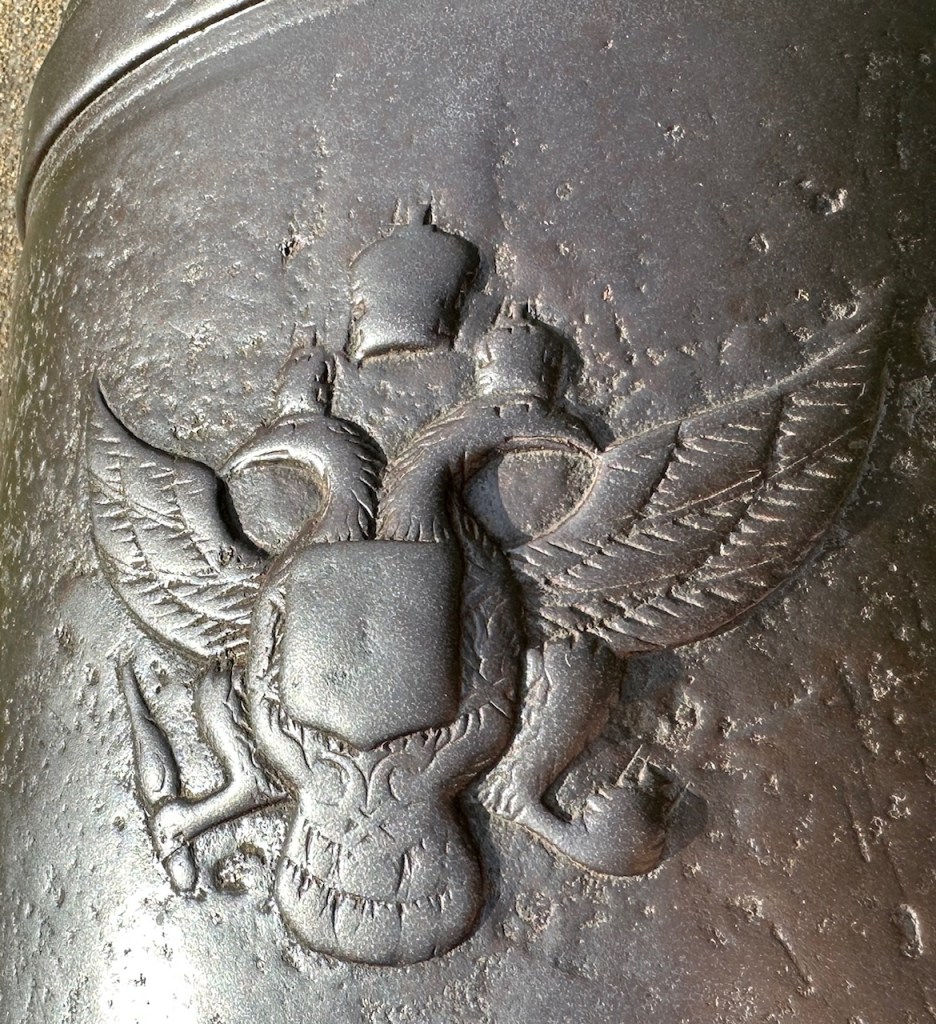
Cast into the top of the gun, on the second reinforce, is the Russian imperial eagle.
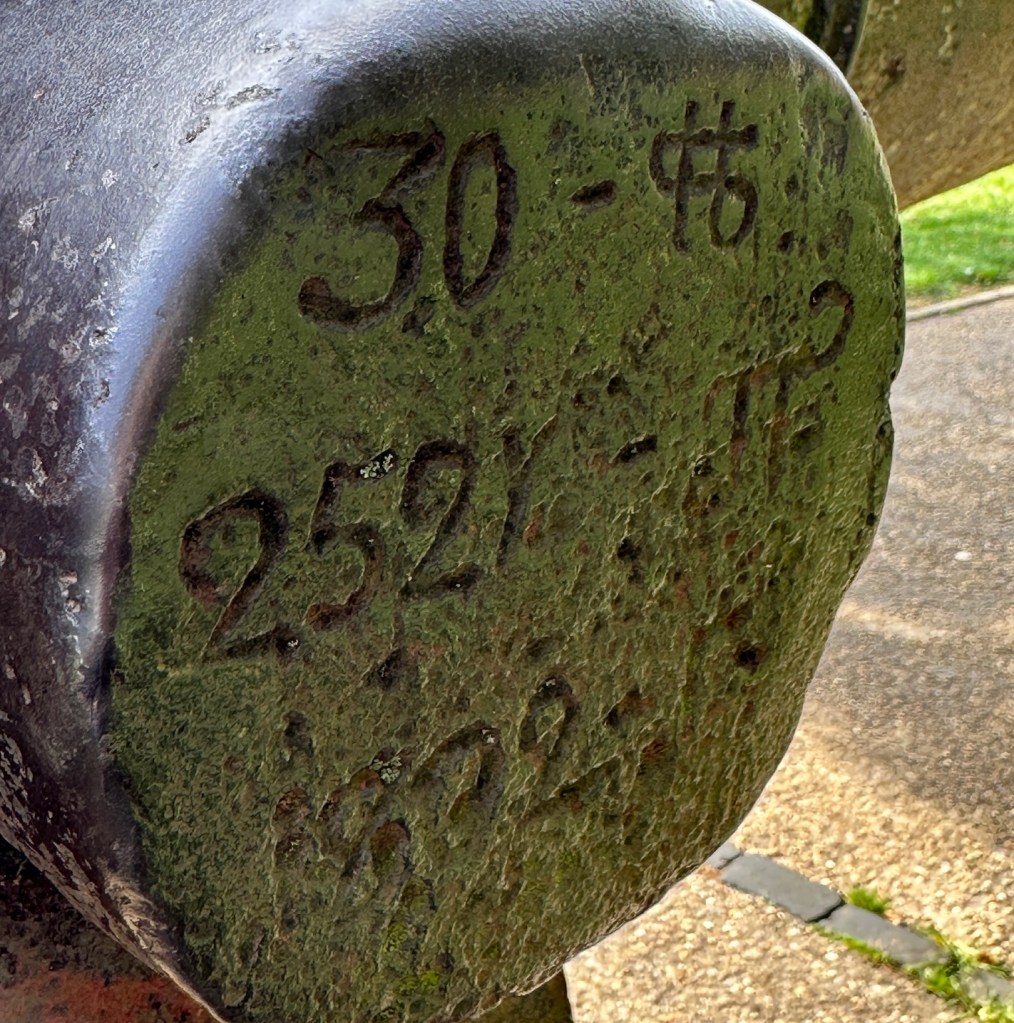
The right trunnion carries some statistical information. At the top is the number 30 followed by a symbol which means funt and indicates the weight of the shot the gun could fire. The Russian funt weighed 14.45oz (0.4kg) as opposed to our Imperial pound which weighed 16oz (0.45kg). Our Ely cannon therefore fired 27lb (12.3kg) shot. The gun is described in the Cambridgeshire Chronicle of 1860 as being a 24 pounder which would have given the people of the day a good idea of the size of the piece but the gun is described today as a 30 pounder.
The numbers in the centre are 252¼ followed by a symbol which means pud. The pud was a Russian measurement of weight that was abolished by the USSR in 1924. 1 pud is approximately 36.2lb (16.38kg) which means that the gun weighs approximately 4 tons, not including its carriage.
And the last line says 1802 G which tells us that the gun was made in the year (Godina) 1802.
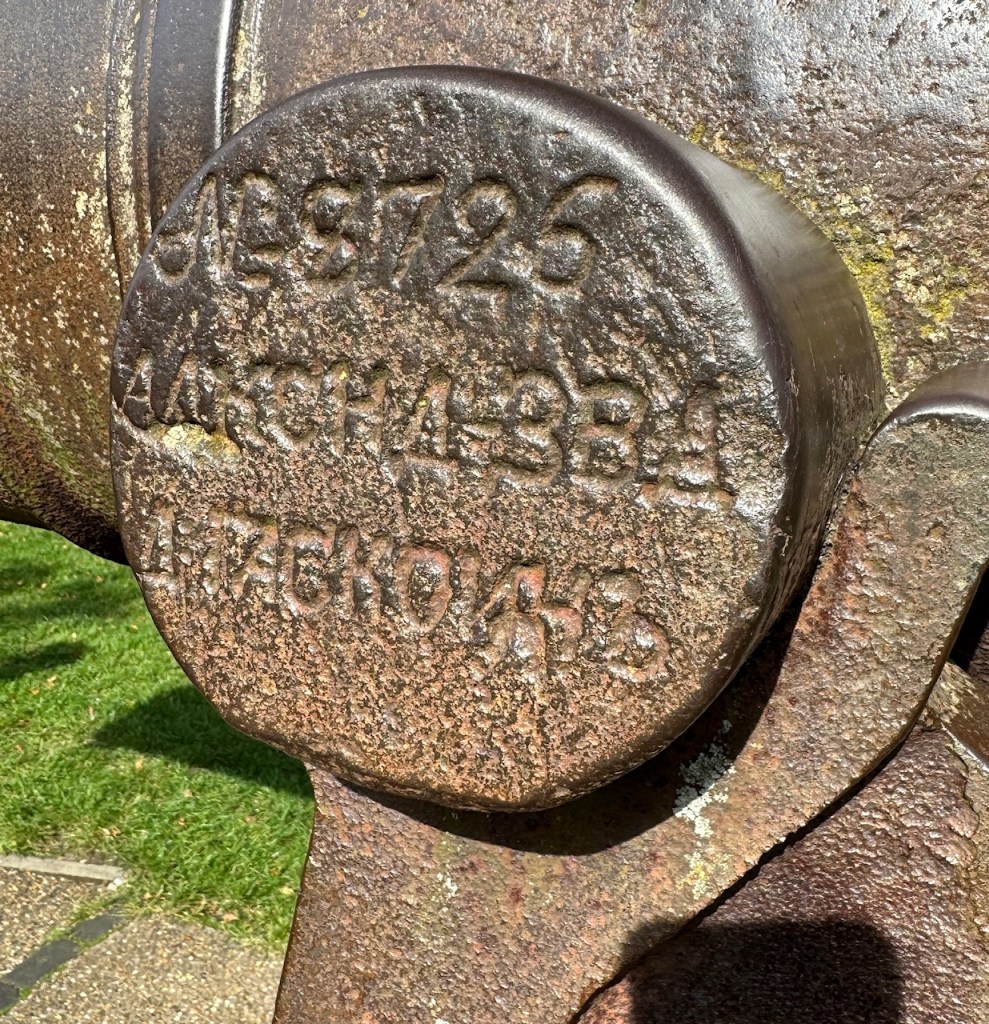
The writing on the left trunnion gives us the cannon’s casting number – Number 8725. The letters in the centre spell ALKSND – ZVD which is an abbreviation for the foundry where the gun was made – the Alexandrovsky Zavod. And the last line says D: GASKOIN which tells us that the Director of the foundry was named Gascoigne.
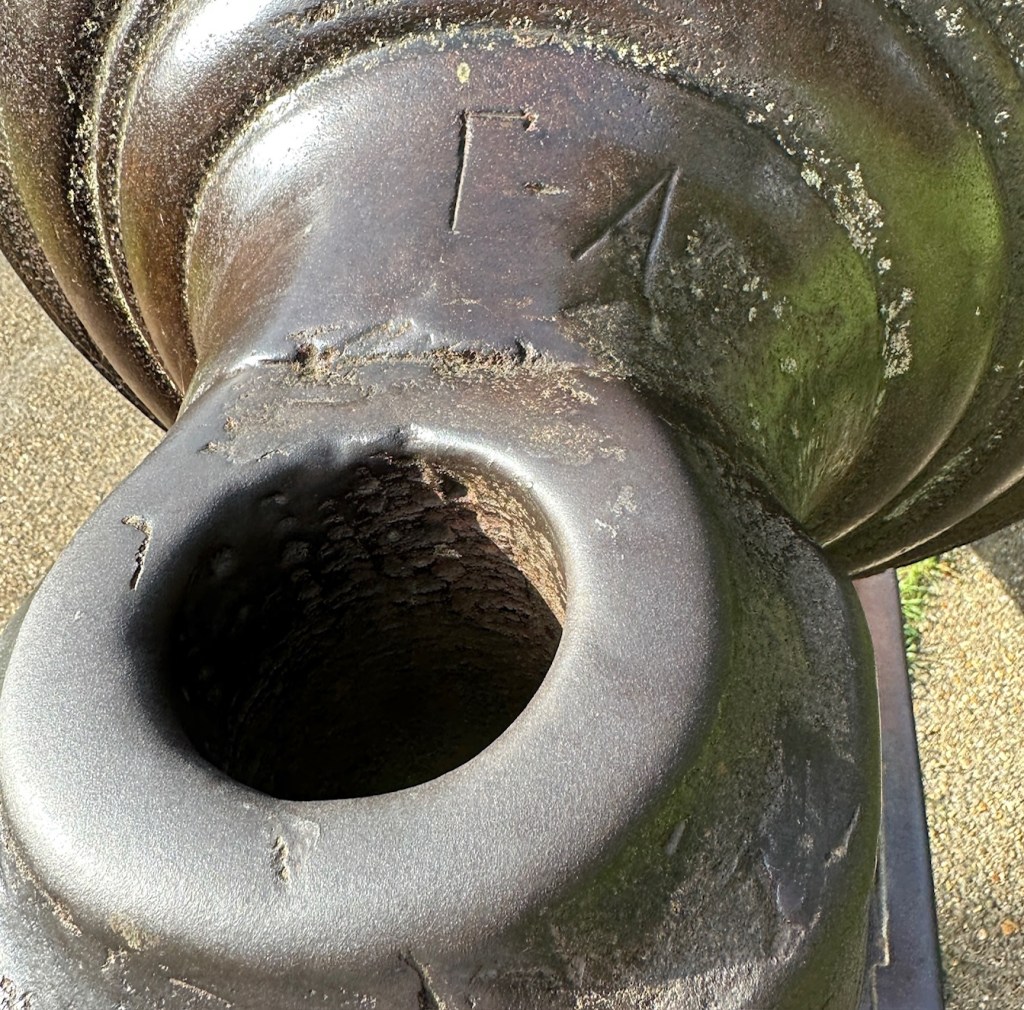
At the breech end, there are two letters inscribed into the iron. These are the Cyrillic letters for GA and may stand for Garnizonnaya Armiya meaning Garrison Army. The GA differentiates our gun from, for example, naval artillery which were stamped MA (Morskaya Artilleria). The breeching loop is horizontal which appears to have been typical for the larger Russian guns. A rope running through the loop may have been used with an adjustment screw for elevating purposes on its original carriage. Naval guns of this period typically had a vertical breeching loop, whilst earlier guns typically had a simple round button instead of a loop.
Most of the Crimean War guns in the UK are later than the Ely cannon and stamped MA for naval artillery. However, there are two guns on display in Tralee, Ireland, and two in the Place du Montreal, Canada, which are almost identical to Ely’s. The Canadian guns’ casting numbers are 8486 and 8741. They were all cast at the Alexandrovsky works in 1802, are 30 pounders weighing 252 pud, and are stamped GA. They are also surprisingly long – the barrels measure 10′ 9½”. They were clearly made to the same pattern, and probably for the same order. There is one very similar gun but a 24 pounder at the Royal Military Academy, Sandhurst. It may be that these 6 guns are the only ones of their type still in existence which would mean that the Ely gun is unique in the UK.
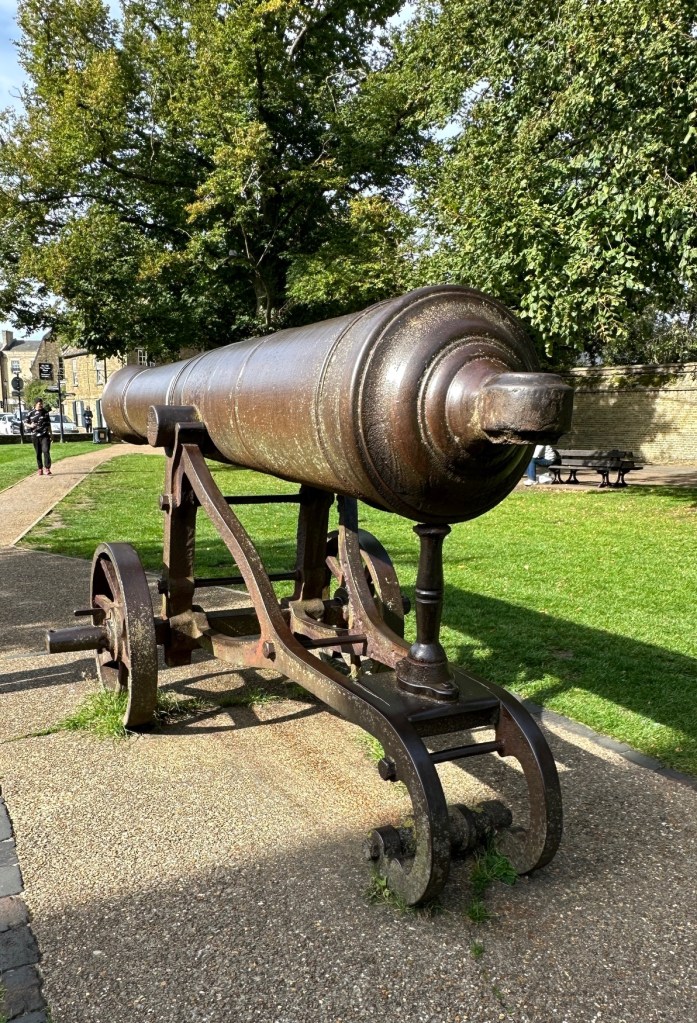
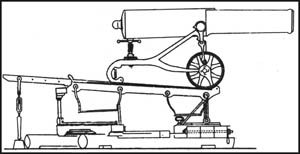
And finally, the Ely cannon is mounted on a very strange-looking ‘carriage’. This was part of the Venglov System (or Système Venglov) which was an iron carriage introduced in 1853 when our gun was already fifty years old. See diagram below. Royal Armouries describe the Venglov as ‘a form of rear-chock garrison carriage of wrought-iron fitted with an elevating screw‘.
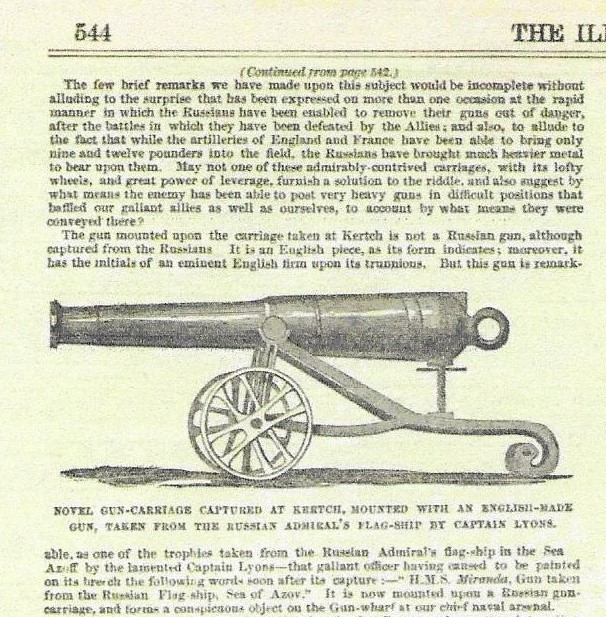
Many of the Crimean War trophy guns are mounted on the same style of carriage. The practicalities of transporting the cannon from Sevastopol to Woolwich would suggest that they did not travel on their original carriages. However, we know from various inventories that a few carriages were brought back from Crimea as well as the guns. This style of carriage was sufficiently novel to warrant a piece in the Illustrated London News, 3rd November 1855:
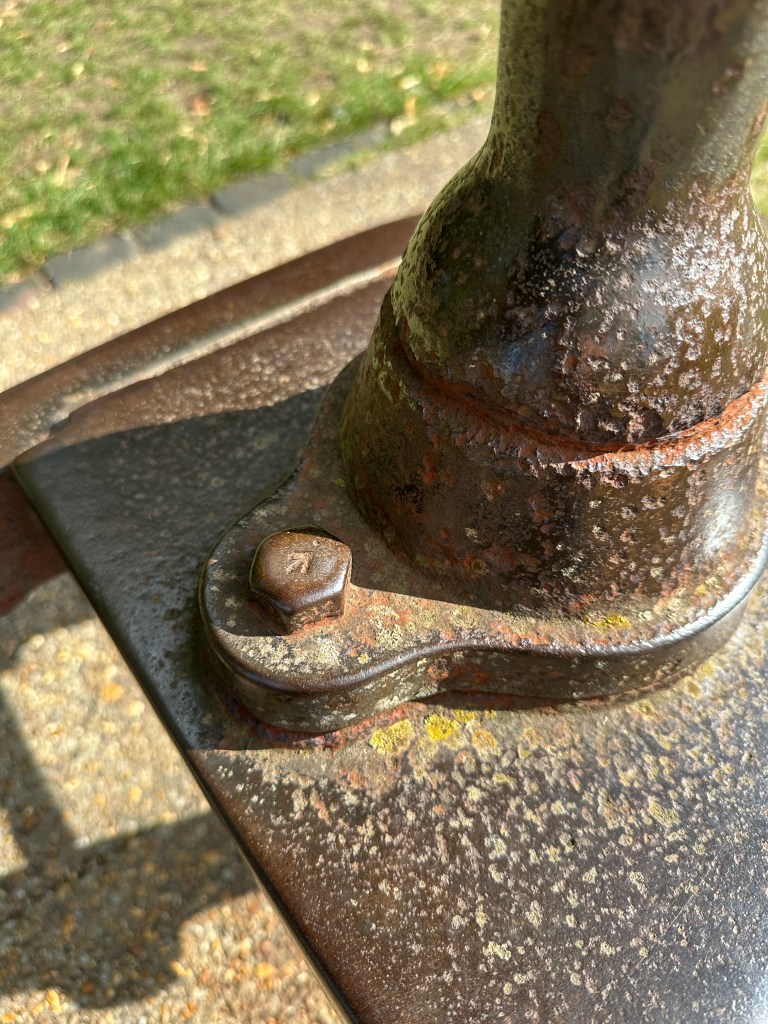
An article in issue 11 of ICOMAM magazine addresses the mounting of the trophy guns. It appears that, when a town requested a gun, ‘the Carriage Department at Woolwich Arsenal offered three different types of carriage available from wrought-iron, cast-iron and wood at £30, £19 and £16 each.’ It appears that most towns opted for one of these ‘admirably-contrived‘ wrought-iron carriages. Where a suitable Russian carriage was not available, one was constructed at Woolwich Arsenal. The practice at Woolwich was to stamp everything they made with the broad arrow and sometimes WD (War Department). The carriage wheels of the guns at Leicester Newarke Houses Museum are stamped with both the broad arrows and WD. On the carriage at Ely, only a few bolts carry the broad arrow. This suggests to me that the carriage is largely original Russian but with repairs!
Sources:
Royal Australian Artillery Historical Company – a great page on cannon https://www.artilleryhistory.org/artillery_register_new/crimean_war_guns/understanding_the_markings_main_page.html
A description of the Venglov System https://osborne.house/profilego.asp?ref=2C3934
Description of Russian 36 pounder on a venglov carriage https://royalarmouries.org/collection/object/object-6171
How a cannon works https://en.wikipedia.org/wiki/Cannon#Materials,_parts,_and_terms
Russian units of measurement, 19th century https://en.wikipedia.org/wiki/Russian_units_of_measurement
Rhynas-Brown, Ruth – ‘Cannon to the left of them, Cannon in front of them: The Crimean trophy guns in Britain and its empire’ ICOMAM magazine, issue 11 (Feb 2014) pp26 – 32 https://drive.google.com/file/d/1ObcrWt-1VQH5nmKqREUa89ipan0osB7S/view
Reilly, W. Edmund M. – An Account of the operations of the Royal Artillery and Royal Naval Brigade before Sebastopol 1854 – 1855, published 1856, appendix XIV
For photos of the cannon in Canada https://www.silverhawkauthor.com/post/artillery-in-canada-russian-crimean-war-trophy-guns
 cannononthegreen.uk